Charles Town's Norfolk & Western Stations
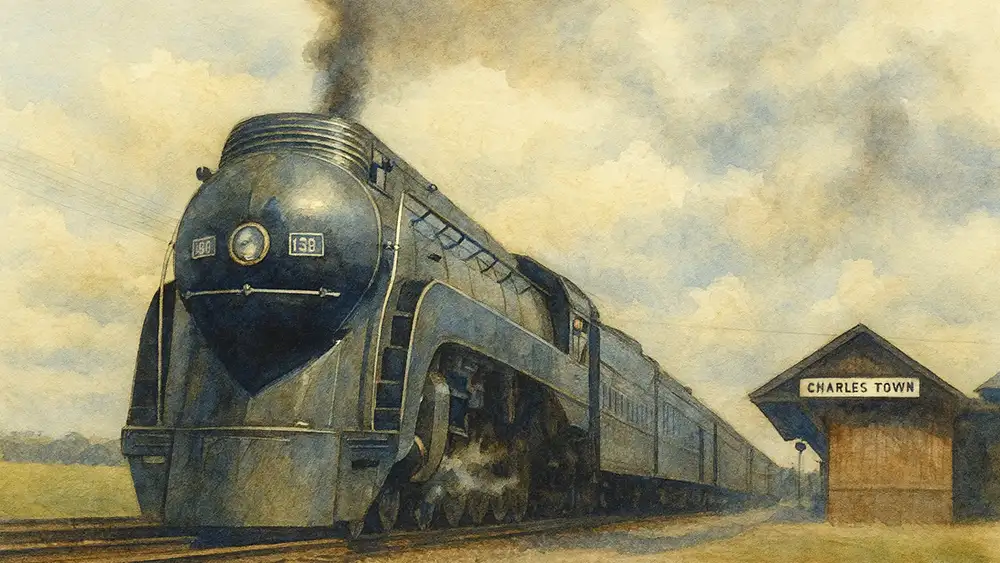
The story of Charles Town’s Norfolk & Western depots is really the story of a second railroad threading its way through Jefferson County, one that linked the town not just to the lower Shenandoah Valley, but to Roanoke, Harrisburg, Philadelphia and New York City. This article looks at the two stations that served that line in Charles Town: a wooden Shenandoah Valley Railroad depot that survives today as a private residence, and a brick Norfolk & Western combination station that stood until its demolition in 2012.
This is meant as a companion to my earlier piece on Charles Town’s B&O depot. Where that article follows the Winchester & Potomac and B&O Valley Line on the east side of town, this one follows the Shenandoah Valley Railroad and its successor, the Norfolk & Western, on the west side.
A second railroad for Charles Town
In the years after the Civil War, Jefferson County leaders were no longer satisfied with relying solely on the Baltimore & Ohio for rail service. The B&O main line along the Potomac and its Winchester & Potomac branch already served the county, but local boosters pushed for a competing north–south route through the Shenandoah Valley. That effort became the Shenandoah Valley Railroad (SVRR), envisioned as a north–south line between Hagerstown, Maryland, and the growing rail center of Roanoke, Virginia.
On March 30, 1870, Jefferson County voters approved $250,000 in bonds to pay for rights-of-way for the new railroad, a significant commitment for a largely rural county.
Construction took most of the 1870s. By December 15, 1879, train service had begun between Shepherdstown and the Shenandoah River. Within that same month, trains were running from Shepherdstown south through Charles Town, Berryville, Ashby and Riverton, finally giving Charles Town a second railroad connection.
By 1882 the line was complete from Hagerstown to Roanoke, and the SVRR had become an important “middle route” in the valley, competing with lines backed by the B&O and the Chesapeake & Ohio.
Train service reached Charles Town before the town had the “proper” station building that survives today. In the early years passengers probably boarded from a simple platform or modest frame structure beside the new line. The surviving frame depot generally dates to the late 1880s, often described as “circa 1888,” and is usually identified as Charles Town’s Shenandoah Valley Railroad station. Later, in the early 1910s, Norfolk & Western built a new brick depot nearby for the Shenandoah Division, while the older frame depot was relegated to secondary uses and eventually became a private residence.
The first station: Shenandoah Valley Railroad’s wooden depot
The earliest substantial passenger facility on the new line in Charles Town was a modest wooden depot. It stood along the Shenandoah Valley Railroad on what is now the west side of town, separate from the B&O’s facilities near North and Mildred streets.
Rail photographer Jon Wright, who has documented stations along the former Shenandoah Valley line, describes the surviving Charles Town depot as a Shenandoah Valley Railroad station built “circa 1888.” In his notes he says the building was moved across the tracks onto a new foundation in 1915, when a brick Norfolk & Western depot was built, and later converted into a private residence. Moves like that were unusual but not unheard of; railroads sometimes sold surplus wooden depots to be relocated when they built larger, more modern replacements.
The building follows a pattern familiar from other small SVRR and N&W depots in the region: a simple rectangular plan with a gabled roof, wide eaves and a bay window for the agent to watch the tracks. It likely combined ticket office, waiting room and small freight space under one roof, a common arrangement on secondary lines where traffic did not justify separate freight and passenger stations.
By the time the SVRR reached Charles Town in 1879, the B&O had already been in town for decades. The wooden SVRR depot therefore functioned as Charles Town’s “other” station, serving a different line and a different set of connections. Where the B&O Valley Line pulled traffic toward Harpers Ferry, Winchester and Baltimore, the Shenandoah Valley route pointed toward Roanoke, Harrisburg and points north.
From Shenandoah Valley Railroad to Norfolk & Western
The Shenandoah Valley Railroad operated from the start in close partnership with the Pennsylvania Railroad and the Norfolk & Western. Financial trouble in the 1880s pushed the SVRR into receivership, and in September 1890 it was sold under foreclosure and reorganized as the Shenandoah Valley Railway. Just a few months later, in December 1890, the line was formally acquired and absorbed by the Norfolk & Western.
Under N&W control, the route became part of the Shenandoah Division. The line between Hagerstown and Roanoke provided a north–south connection west of the Blue Ridge that could be paired with Pennsylvania Railroad trackage to carry passengers and freight all the way to Philadelphia and New York.
At its height in the years just before World War I, Charles Town saw a surprisingly busy Norfolk & Western timetable. In 1910, the Shenandoah Division employee schedule shows six first-class passenger trains a day at the N&W depot, three northbound and three southbound, linking the town with Hagerstown, Roanoke and intermediate Shenandoah Valley communities.
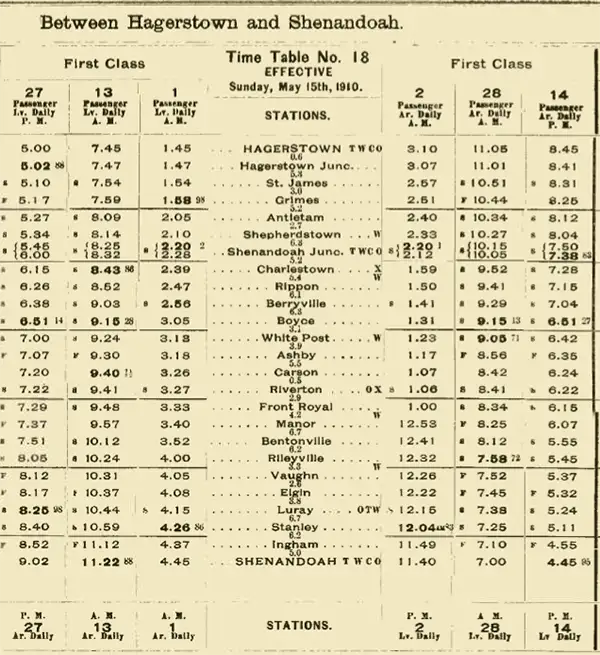
By the mid-20th century, that service level had decreased. By 1963, N&W operated just one passenger train each way on the Shenandoah Valley Route, before ending passenger services later that summer.

The brick Norfolk & Western station (1913–14)
As traffic increased and standards evolved, Norfolk & Western replaced the original wooden depot at Charles Town with a more durable brick station. A set of surviving N&W architectural drawings for the Charles Town passenger station, including floor plans and elevations, is dated June 26, 1913. Although the exact construction date isn't known, these drawings indicate the building was likely designed in 1913 and probably completed shortly after, around 1913–14.
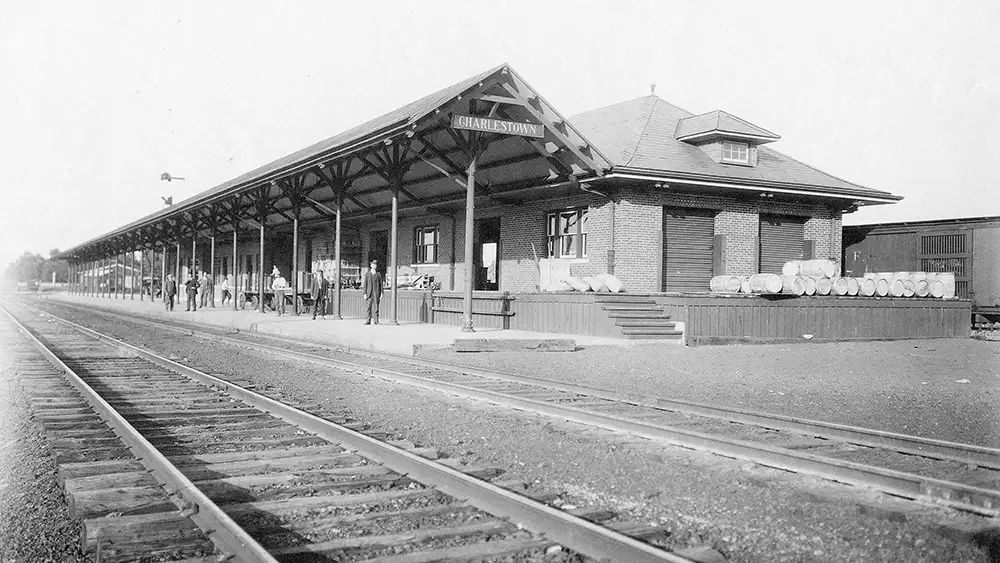
Inside, the Charles Town depot followed a typical early twentieth century Norfolk & Western combination-station plan, but with every public space divided by race. A central ticket office bay faced the tracks, with a record room behind it, flanked on one side by a large “Waiting Room – White” and on the other by a separate “Waiting Room – Colored.” Each waiting room had its own set of toilets, and the white side also included a small women’s retiring room. A baggage and express room occupied the far end of the building. The surviving N&W floor plans, dated June 26, 1913, make it clear that segregation was built into the station from the start, right down to duplicated restrooms and doors.
The brick depot stood on the east side of the tracks, roughly midway between Summit Point Pike and Middleway Pike (now Martin Luther King Jr. Boulevard), just south of the road crossings that still carry traffic today. A railfan guide to Norfolk Southern’s Hagerstown line describes it as a “large brick ex–N&W station” in that location, serving both passenger and freight traffic.
The brick station was a true combination depot, handling both passenger and freight business for N&W in Charles Town. Period photos show a low, broad-shouldered brick building under a tall hipped roof punctuated by dormer windows, with large freight doors and platform space that could serve both express and less-than-carload shipments, along with waiting rooms and office space inside.
Two railroads, two directions
Around 1910, Charles Town was effectively a two-station town. On the east side, the B&O Valley Line timetable showed four passenger-carrying trains in each direction between Harpers Ferry and Strasburg, six of them regular passenger runs and two mixed passenger–freight locals to serve small towns along the branch. On the west side, the Norfolk & Western Shenandoah Division brought six first-class passenger trains a day through its brick depot, three northbound and three southbound.
The B&O pointed travelers toward Harpers Ferry, Baltimore and Washington. N&W pointed them toward Roanoke, Harrisburg and New York via the Pennsylvania Railroad. For a few decades before World War I, someone standing in Charles Town could choose between two very different sets of destinations simply by walking to a different station.
On paper the two railroads looked equal – each with its own depot and timetable – but in railroad terms they were very different. The Norfolk & Western’s Shenandoah Division was a main line between Hagerstown and Roanoke, carrying through Pullman cars to New York, while the B&O’s Valley Line was a branch off the Potomac main that mostly handled local and mixed trains.
Passenger trains on the Shenandoah Valley Route
Although Charles Town never enjoyed the volume of service seen at larger valley towns, it sat on a line that carried surprisingly far-flung passenger traffic.
N&W timetables from the mid-twentieth century show the Shenandoah Division’s trains 1 and 2 running as part of a through service between Roanoke and New York, in cooperation with the Pennsylvania Railroad. Northbound cars were handed off at Hagerstown and carried over PRR rails via Harrisburg to Philadelphia and New York; southbound cars made the reverse journey.
For local residents, these trains meant that a traveler boarding at Charles Town could reach Roanoke or Harrisburg directly, and by staying aboard a through car, could ride overnight to New York or points in between. Smaller local and mixed trains also worked the line over the years, handling mail, express and local freight.
As automobiles, buses and improved highways spread through the valley after World War II, passenger traffic dwindled. N&W gradually cut back service on the Shenandoah route, just as the B&O did on its Valley Line to Strasburg.
Passenger service over the Shenandoah Valley Route as a through corridor ended by the summer of 1963, according to the Official Guide of the Railways and later summarized histories. A local rail preservationist in Inwood, West Virginia, writing in 2012, recalled that passenger service at Charles Town had ended “about 1962 or so,” which matches the broader timetable evidence. By that point the Baltimore & Ohio had already dropped passenger trains from its Valley Line to Strasburg in 1949, leaving the Norfolk & Western as Charles Town’s only remaining rail passenger service for more than a decade.
After the last train: freight, quiet years and demolition
Once passenger trains stopped calling, the brick N&W depot saw only freight and express business, and even that declined as truck traffic increased. By the late twentieth century the station was no longer needed for daily railroad operations.
The building survived into the early 2010s. Railfan photos and trip guides for Norfolk Southern’s Hagerstown line still show a “large brick ex–N&W station” standing between Summit Point Pike and Middleway Pike at Charles Town. Demolition was under way by August 9, 2012, as contemporary photographs from that date show heavy equipment tearing into the structure, and the depot was completely gone by later that month.
A railfan tour guide for the Norfolk Southern line through Charles Town notes that the “large brick ex-N&W station” on the east side of the tracks between Summit Point Pike and Middleway Pike “was demolished in August 2012.” A post on Railway Preservation News dated August 25, 2012, titled “N&W Station Demolished at Charles Town, W.Va.,” reports that the station had been torn down “in the last couple of weeks,” describes it as a “new” depot dating from roughly 1913 and notes that it had stood vacant for many years after passenger service ended, with only occasional freight-related use. In the same post, the author points out that the earlier station had been moved across the tracks and converted into a house, where it still survives.
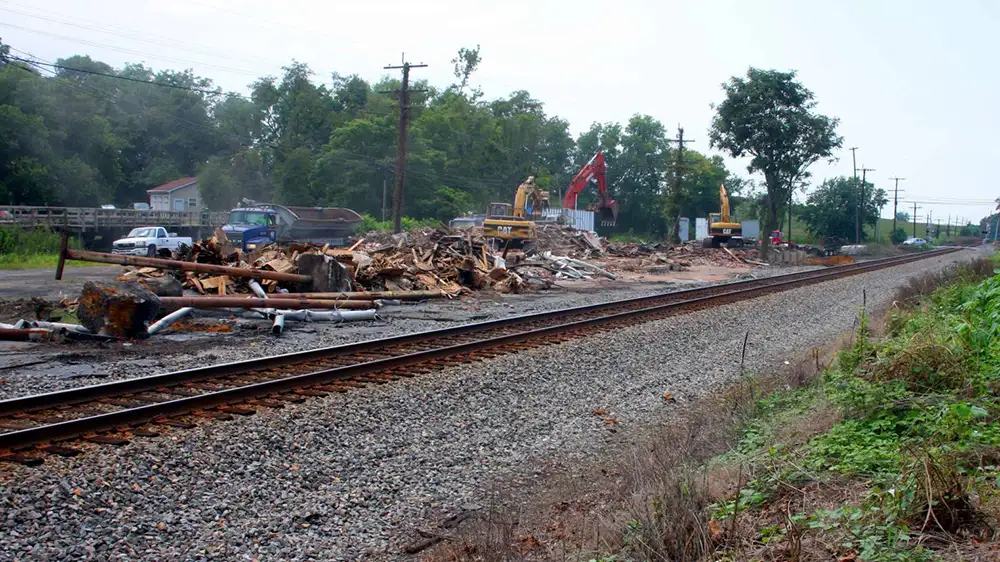

Today, Norfolk Southern freight trains still roll past the site, and local rail photographers continue to use the area near Summit Point Pike and Middleway Pike as a vantage point. In a November 2012 photograph, train 38Q passes the former station site, with the depot already gone but the right-of-way and surrounding landscape clearly recognizable.
Two lost stations and a lesson we should have learned
Charles Town has already lived through one classic preservation “tragedy.” The Victorian Baltimore & Ohio depot that once stood at North and Mildred was demolished in the 1960s, in the same era that New York’s original Pennsylvania Station was torn down. Those losses helped galvanize the modern historic preservation movement. In hindsight, we explain them away by saying that preservation was not yet at the forefront, that the tools and public awareness simply were not there.
By 2012, that excuse no longer applied. Charles Town’s historic districts were on the National Register, other N&W depots in towns like Luray and Boyce were being restored for museums and community use, and the destruction of Penn Station had been a cautionary tale for half a century.
Yet the brick Norfolk & Western depot at Charles Town followed the same script. Long vacant, increasingly deteriorated and still owned by a freight railroad that viewed it as a liability rather than an asset, the building slipped away without a local buyer, a reuse plan or a funding package in place. On paper, demolition was the cheapest solution. On the ground, it meant that the town lost a second passenger station within living memory, this time in an era when we should have known better and had examples of how to do things differently.
Today the only physical reminder of the Shenandoah Valley route in Charles Town is the relocated wooden depot, hiding in plain sight as a private home. It is a small, weathered survivor of the years when two railroads met here and trains from Roanoke and New York alike rolled past the edge of town – and a quiet reminder of what the community managed to save, and what it did not.